How to Choose Stand Up Pouches for Food Packaging in 2026?
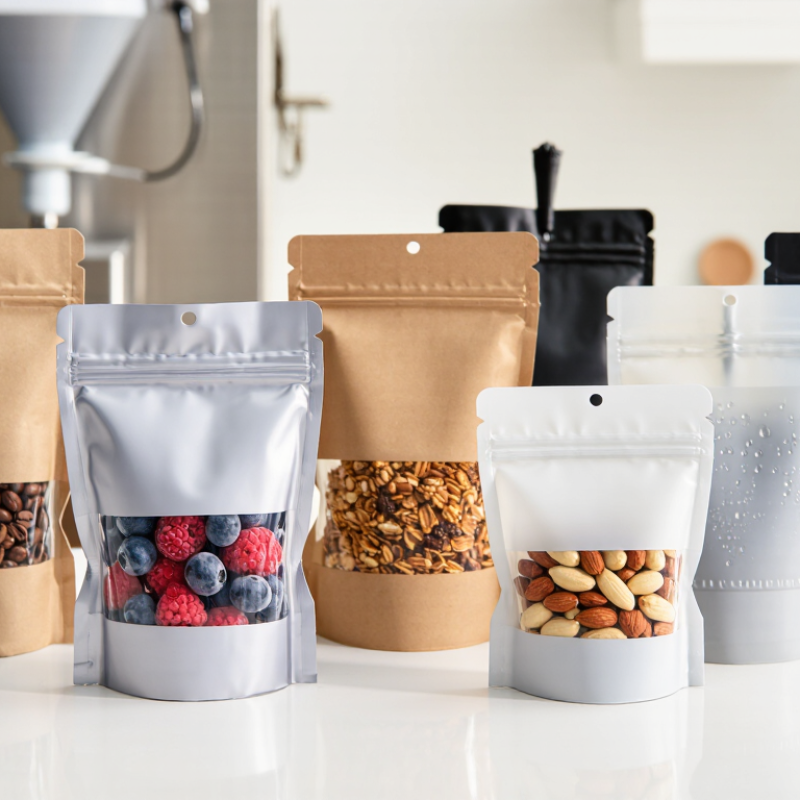
Choosing stand up pouches for food packaging in 2026 requires more than selecting attractive colors or a convenient zipper. The pouch must protect food, support efficient filling, and survive transport without leaking. A roasted-coffee pouch may face oxygen exposure, while a frozen-fruit pouch must tolerate cold storage and rough handling. Different foods demand different structures.
Walter Soroka, a recognized packaging-technology educator, describes packaging as “the science, art, and technology of enclosing and protecting products for distribution, storage, sale, and use.” This principle remains practical today. A strong pouch decision begins with the product. Consider moisture sensitivity, oxygen exposure, oil content, filling temperature, and expected shelf life. Then examine laminate structure, seal strength, puncture resistance, zipper performance, and barrier protection. A matte finish may improve shelf appeal, but it cannot compensate for weak seals.
Real production conditions often reveal uncomfortable details. A pouch that performs well in a sample test may wrinkle near the seal during high-speed filling. A convenient spout can complicate recycling goals. A low-cost film may increase waste if damaged units reach the packing line. No pouch wins every test. Teams should compare samples under heat, compression, vibration, and storage conditions. They should also review supplier traceability, food-contact documentation, and quality-control records. Sometimes the better choice is not the cheapest pouch. It is the one that creates fewer failures across its entire life cycle. A careful 2026 selection process should balance protection, usability, sustainability, appearance, and measurable manufacturing performance.
Define the Main Requirements for Your Food Packaging
How to Choose Stand Up Pouches for Food Packaging in 2026?
Define the Main Requirements for Your Food Packaging
Start with the food, not the pouch shape. Define moisture, oxygen, light, aroma, fat, and heat sensitivity. FAO reported that 13.2% of food was lost globally before retail in 2022. Suitable packaging can help protect quality during storage and transport. It cannot repair poor processing.
Set a realistic shelf-life target. Then request barrier data from the pouch supplier, including oxygen transmission rate and water vapor transmission rate. Match those results with your filling temperature, storage climate, and distribution distance. A dry snack may need strong moisture protection. Coffee often needs oxygen and aroma control. Frozen food requires seal flexibility at low temperatures.
Check the production details carefully. Confirm pouch dimensions, filling speed, seal width, zipper performance, and drop resistance. FPA’s 2024 industry report places annual U.S. flexible packaging sales near 40 billion dollars. The scale is significant, but material choice still depends on application. A thinner structure may reduce material use. It may also create more punctures. That trade-off deserves testing.
Opening experience matters, too. Measure tear force with real users, not only laboratory tools. Ask whether the pouch can stand steadily on a crowded shelf. Review print durability and batch-code visibility. Sustainability claims need evidence, such as material composition, recyclability guidance, and verified life-cycle data. A pouch can look responsible and still perform poorly. I would test filled samples for several weeks before approving production. Perfect requirements rarely exist. Weak assumptions do.
How to Choose Stand Up Pouches for Food Packaging in 2026? — Define the Main Requirements for Your Food Packaging
| Packaging Requirement | Typical Food Application | Recommended Pouch Specification | Useful Performance Target | Why It Matters | How to Verify Before Approval |
|---|---|---|---|---|---|
| Moisture protection | Dry snacks, cereal, flour, powdered ingredients, dehydrated foods | Use a heat-sealable multilayer structure with a moisture-resistant inner layer. Select a high-barrier structure when the product is hygroscopic or has a long shelf-life target. | Set a water vapor transmission rate target according to the product's water activity and shelf-life study. For highly moisture-sensitive foods, a target below 0.5 g/m²/day is commonly considered a strong barrier level when tested under standard conditions. | Moisture ingress can cause loss of crispness, clumping, texture changes, and microbial risk. | Review WVTR test results, conduct accelerated shelf-life testing, and compare product texture and water activity over time. |
| Oxygen protection | Roasted coffee, nuts, oily snacks, meat snacks, powdered nutrition products | Choose an oxygen-barrier layer such as coated film, metallized film, or foil-based laminate when oxidation is a major concern. Consider nitrogen flushing for oxygen-sensitive products. | For oxidation-sensitive foods, an oxygen transmission rate below 1.0 cm³/m²/day is often used as a demanding target; the final value should be based on the product's fat content, oxygen sensitivity, and shelf-life requirement. | Oxygen can accelerate rancidity, color loss, flavor deterioration, nutrient degradation, and aerobic microbial growth. | Check OTR reports, measure residual oxygen after filling, and perform sensory and chemical oxidation testing. |
| Light protection | Light-sensitive oils, dairy powders, spices, coffee, vitamin-containing foods | Use an opaque or metallized structure when ultraviolet or visible light can affect quality. A printed outer layer should be protected by a suitable film configuration. | Define a maximum light-transmission level based on the product's sensitivity; opaque structures provide the strongest practical protection. | Light exposure may cause oxidation, fading, off-flavors, and degradation of light-sensitive nutrients. | Request light-transmission data across relevant wavelengths and conduct comparative storage tests under controlled lighting. |
| Seal integrity | All food products, especially powders, oily foods, and products exposed to distribution stress | Specify a compatible sealant layer, adequate seal width, clean sealing surfaces, and a seal design suitable for the filling line. Use a zipper only as a reclosure feature; it does not replace the primary hermetic seal. | Establish minimum seal strength and leak-rate limits through a validated packaging process. Many applications use a seal width of approximately 8–12 mm, but the correct width depends on the structure and equipment. | Weak or contaminated seals can cause leakage, oxygen entry, moisture ingress, and food-safety failures. | Perform seal-strength testing, dye or vacuum leak testing, burst testing, and visual inspection at production speed. |
| Product compatibility | Acidic foods, fatty foods, salty products, sauces, powders, and products with sharp particles | Select an inner contact layer that is suitable for the food type and filling temperature. Increase puncture resistance for products containing bones, chips, granules, or hard inclusions. | Use food-contact-compliant materials and confirm resistance to the product's oils, acids, salts, aromas, and moisture. | Incompatible materials can lead to odor transfer, flavor scalping, seal degradation, swelling, or loss of barrier performance. | Conduct food-contact compliance review, migration testing where required, odor and flavor testing, and compatibility trials with the actual product. |
| Puncture and abrasion resistance | Frozen foods, pet treats, chips, granola, nuts, pasta, and products with irregular edges | Choose a thicker or tougher laminate and consider rounded pouch corners, reinforced seals, or a bottom-gusset design. | Define minimum puncture, tear, and drop-test requirements based on pouch size, fill weight, stacking, and shipping conditions. | Damage during handling can create invisible channels that compromise the barrier even when the pouch appears intact. | Use puncture testing, drop testing, compression testing, and simulated transport trials with filled pouches. |
| Pouch size and fill weight | Single-serve, family-size, refill, and bulk food formats | Select a pouch height, width, bottom gusset, and headspace that allow stable standing, efficient filling, and comfortable pouring. | Typical retail stand-up pouches may range from approximately 100 g to 2 kg of contents, depending on product density and pouch construction. | Correct sizing reduces excess material, improves shelf presentation, limits product movement, and supports accurate filling. | Run filling trials using the actual product density, check pouch stability, measure headspace, and verify net-weight accuracy. |
| Reclosure and dispensing | Snacks, dried fruit, nuts, powders, pet food, and products consumed over multiple occasions | Choose a zipper, slider, spout, tear notch, or laser-scored opening according to the product and user behavior. Use a tamper-evident feature when required by the market or product risk assessment. | Reclosure should remain functional after repeated opening cycles and should not interfere with the primary seal or filling process. | Convenient opening and reclosing can improve portion control, product freshness, and consumer usability. | Test opening force, reclosure performance, leakage after reclosing, zipper contamination tolerance, and consumer handling. |
| Heat resistance or retort suitability | Hot-filled sauces, ready meals, soups, wet foods, and shelf-stable products processed in the package | Use a structure specifically engineered and validated for hot filling, pasteurization, or retort processing. Standard dry-food pouches should not be assumed to be suitable for thermal processing. | Specify the exact process temperature, time, pressure, and cooling conditions; retort applications may involve temperatures around 121°C, depending on the process. | Thermal processing can weaken seals, distort films, reduce barrier performance, and affect food safety if the package is not designed for it. | Complete process validation, seal testing after processing, burst and leak testing, and microbiological shelf-life validation. |
| Transparency and product visibility | Granola, confectionery, dried fruit, snacks, and premium visual products | Use a clear window or transparent structure when visual inspection is important. Avoid transparency when light sensitivity is more important than product visibility. | Define the required window area and acceptable haze or clarity level without compromising the necessary barrier performance. | Visibility can support purchase decisions, while excessive exposure to light may shorten product quality life. | Evaluate clarity, haze, print appearance, light transmission, and product quality after storage. |
| Sustainability objectives | Brands seeking lower material use, improved recyclability, or reduced packaging impact | First reduce unnecessary material and pouch size; then assess mono-material structures where local recycling systems accept them. Use high-barrier laminates only when product protection requires them. | Compare material weight, recycled content where legally and technically appropriate, recyclability eligibility, and product-loss risk using the same functional performance criteria. | Packaging impact includes material production, transport, disposal, and food waste caused by inadequate protection. | Check local collection and recycling rules, obtain material composition data, conduct life-cycle comparisons, and validate shelf life before making claims. |
| Regulatory and labeling compliance | Food products sold across domestic or international markets | Use food-contact materials that meet the requirements of each target market. Reserve sufficient printable area for mandatory declarations, lot codes, dates, nutrition information, and disposal instructions. | Confirm applicable food-contact, labeling, allergen, traceability, and environmental-claim requirements before artwork approval. | Compliance failures can cause product recalls, shipment delays, relabeling costs, or removal from the market. | Complete a documented compliance review with current regulations, supplier declarations, migration documentation, and print-proof approval. |
| Supply-chain and machine compatibility | High-volume filling, automated pouching, and multi-format product lines | Match pouch dimensions, film stiffness, zipper profile, tear notch, coefficient of friction, and seal window to the filling equipment. | Define acceptable tolerances for dimensions, film thickness, seal temperature, dwell time, pressure, and line speed. | A pouch that performs well in laboratory testing may fail on a high-speed filling or packing line. | Run production-line trials, monitor seal quality, record downtime and reject rates, and validate performance after transport. |
Note: Performance values are practical starting points rather than universal specifications. Final requirements should be confirmed through product-specific shelf-life studies, food-contact compliance reviews, packaging-process validation, and distribution testing under the intended market conditions.
Related Posts
-
China Best Stand Up Food Pouches Manufacturer?
-
Innovative Stand Up Pouches Transforming Food Packaging with Market Growth Projections
-

2025 Top 10 Stand Up Food Pouches for Convenient and Stylish Snacking
-

China Top Packaging Supplies Manufacturers for Global Buyers
-
How to Choose the Best Cookie Packaging Supplies for Your Business?
-
How to Start Box Printing for Your Small Business?